
Irish Wolfhound
Cú Faoil, Wolfhound
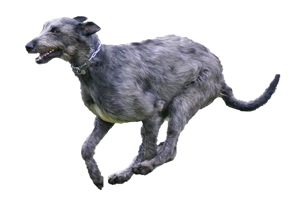
The tallest breed in the world, the Irish Wolfhound is a sighthound that was once used to hunt wolves, boar and other prey. They were so adapt to the task that both of these animals are now extinct in Ireland. These hounds were also kept for war, it was said in battle they could take a man off a horse’s back. Today they are kept almost solely as companions.
Irish Wolfhound Standards
- 27-30"
- 60-70 lbs
- extra large sighthound
- small ears with a long tail
- coat is wiry and rough to the touch
- black
- brindle
- fawn
- grey
- red
- white
History of the Irish Wolfhound
For centuries dogs that resemble today’s Irish Wolfhound have existed in Ireland, originally having either a smooth or rough coat. These dogs were known by many names, such as Irish Dogs, Greyhounds or Wolfdogs of Ireland. The Celtics called them Cú Faoil, which translates to 'Hound Wolf'. It is impossible to know how long these dogs were present on the island, or how they got there. The most common theory is that their ancestors were brought by Phoenician traders 3,000 years ago, while others believe they are descendants of the Scottish Deerhound. Legend states that they were used to hunt the giant Irish Elk, which has been extinct for over 7,000 years. Written record exists of the breed in 391 AD when seven of them were gifted to a Roman Consul.
Traditionally only royalty was allowed to own the Irish Wolfhound and gifted them throughout Europe and Asia, sending them to countries such as England, Spain, France, Sweden, Denmark, Persia, India and Poland. Due to the limitations of owning the breed and their exportation, as well as the extinction of wolves, they were almost completely wiped out by the 19th century. Thanks to an enthusiast named Captain Graham the dogs survived, however the breed we have today is actually a recreation of the line. Graham obtained some of the few remaining hounds that fit the wolfhound type in Ireland and crossed them with the Scottish Deerhound, Great Dane, Borzoi, Great Pyrenees, and Tibetan Mastiff.
Related Breeds: