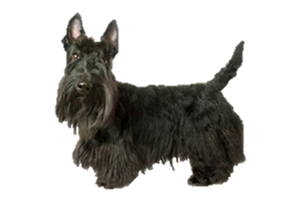
![]() Scottish Terrier The Scottie of Aberdeen The mention of Scotland and terrier instantly brings to mind the vision of this wiry and charming breed, easily recognizable worldwide. Appearance
The Scottish Terrier is a small, sturdy breed with short legs and a head that is long in proportion to the rest of their body. They stand at 10-11 inches and weigh in at 19-23 pounds. Their ears are pricked and their tail is medium in length, carried either straight or slightly curved. They have a harsh, wiry topcoat with a soft undercoat. Traditionally the coat is kept longer on the beard, eyebrows, legs, and lower half of the body. Colors include black, wheaten, or brindle; a small amount of white on the chest is allowed. History
Developed in the 1700s, the Scottish Terrier (or Scottie) was originally known as the Aberdeen Terrier after the Scottish town of the same name. Like other terriers they were used to hunt and kill vermin mostly on farms with prey including badgers and foxes. Being a favorite of King James the VI brought a rise in popularity to the breed and the Fourth Earl of Dumbarton nicknamed the breed “the diehard”. Closely related to the Cairn and West Highland White Terriers, these three dogs were in fact once classified under the heading of ‘Skye terriers’ along with what would become the breed of the same name. They would not receive individual recognition by the Kennel Club (KC) until 1930. Temperament Health and Care The life expectancy of a Scottish Terrier is normally between 12-15 years. They are prone to Von Willebrand’s disease, craniomandibular osteopathy, flea and skin allergies, and Scottie Cramp, which causes spasams along with hyperflexion and hyperextension of the legs. Some studies have shown that Scottish Terriers are 20 times more likely to develop bladder cancer than other breeds. Scottish Terriers can live in an apartment provided they have a daily walk. Care needs to be taken when allowed off leash because of their prey drive. If their coat is kept at its traditional length regular brushing is required to prevent matting. Professional grooming should be done at least twice a year, more frequent if a shorter coat is desired. |
|