
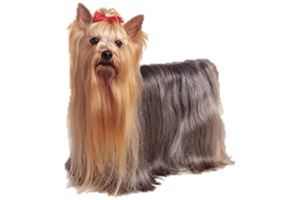
![]() Yorkshire Terrier Still a Terrier at Heart The Yorkshire Terrier is perhaps the most popular terrier worldwide. Originating in Yorkshire, England, this little dog was once used as an accomplished ratter. Appearance
Yorkshire Terriers are a small, toy sized breed, standing at 9 inches and weighing only 5-7 pounds. They have a long, straight, silky coat that when left uncut easily trails the ground. Yorkshire Terriers are always a dark steel blue (almost black) with tan on their head, chest, and forelegs. History
It is believed the Yorkshire Terrier was developed by Scottish miners and mill workers in order to have a small, pocket-sized ratter. They originated in the early 1800s in the West Riding area of Yorkshire. The breed was created through several crosses, including the Black and Tan, Dandie Dinmont, Skye, and the now extinct Clydesdale and Paisley Terriers. It is also generally accepted that the Maltese was included in its development. Originally the breed was known as the Broken-haired Scottish Terrier and was larger (some as large as 30 pounds) then it is today. Although the Yorkshire Terrier is now only kept as a companion, it still retains much of its early terrier instincts. Temperament
The appearance of the Yorkshire Terrier can often fool one unfamiliar with the breed, especially one kept to show standards. They are oblivious to the fact that they are little dogs, they are highly energetic and eager to go wherever you are. Some dogs suffer from separation anxiety, and if allowed to will take over the household. Often spoiled from the moment they come home because of their small size they can easily become demanding, overly jealous, and snappish. They are notoriously hard to housebreak, and can often be “yappy” and bark at the littlest of sounds. Like any breed Yorkshire Terriers need to be properly trained, and with the right owner they are sweet, loyal dogs and make great companions. Health and Care
Yorkshire Terriers, like all toy breeds, are fragile dogs. They can be injured or killed if stepped on or when jumping from high places, such as their owners arms, the back of the couch or bed. They are prone to bronchitis and often have a delicate digestion. Early tooth decay is also common, and often have difficult times birthing because of their size. Other genetic disorders include, Distichiae (eyelashes growing in an abnormal location), Legg-Perthes disease, and Luxating patellas. Life expectancy for the breed is 12-15 years. The tiny Yorkshire Terriers, marketed as “teacups”, often have more health and behavioral issues, most often caused by an increased fragility and inbreeding. The Yorkshire Terrier will adapt well to apartment life, they are active indoors and don’t need a yard, but they enjoy running in a safe, enclosed area. They are playful and energetic dogs, and while play takes care of a lot of their energy they should still be taken on a daily walk. Yorkshire Terriers prefer warmer climates. Even clipped the Yorkshire Terrier requires regular grooming or their coat will quickly become a mess of mats. If kept show length it requires lengthy daily care, the topknot is usually kept tied back, if not it falls in their eyes and face. If kept short the coat generally requires a quick brush daily and a trip to the groomer every 6-8 weeks to keep it in good condition. Yorkshire Terriers shed very little hair.
|
|