
|
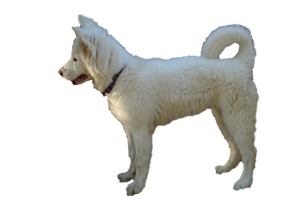
Poongsan Rare Korean Dog The Poongsan is a breed of dog that originates from Korea. Very little is known about the breed outside of Korea, there is little information even in South Korea. The majority of the Poongsans that exist today are found in North Korea. In appearance the Poongsan looks much like another native Korean dog, the Jindo. They are larger then their cousins and are a spitz-type breed. Their ears are pricked and their tails are curled and carried along the back. They have a thick double coat that is most often a creamy white; however it is not a true white. It is important to do thorough research when purchasing this breed. Quite a few “Poongsans” have been sold, it is only later when the new owner finds out they may have Poongsan somewhere in their ancestry. With the little information available on the Poongsan dog it is even more difficult to know the history of the breed. Some believe that the breed is a descendent of the Lakia dogs of Siberia, and others believe that the breed was tamed back as far as the New-Stone Era. It is known that the breed was isolated in the Baiku Mountain area, making it quite pure and uncontaminated by other dogs. Originally the breed was used for hunting and as a watchdog. Like all other Korean dogs the breed was heavily slaughtered for its fur by the Japanese during WWII. After the war they were recognized as a national treasure, a title they share with the Jindo and Sapsaree. After the Korean War it was impossible for anyone outside of North Korea to obtain one of these dogs, in truth most dogs that were brought to South Korea in the 1990s were not true Poongsans. In 2000, however the North Korean President gifted the South Korean President with two true pups. Careful breeding is being controlled of these two lines. Some dogs have made their way to the United States, although it is likely that the only legitimate dogs are decedents from the first group exported, known as the KNDA Poongsans. Most are pushing for the American breed dogs to be known as the American Pungsan. |
|