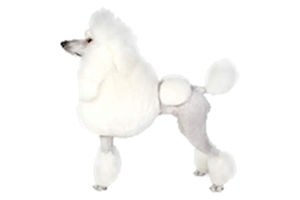
Poodle More Than Just Looks The Poodle is a breed of dog that originated in Europe, although the exact country is severely debated. Often dismissed because of looks, the Poodle is one of the smartest breeds of dog. Appearance
There are a variety of poodles, but mostly vary only in size (see Corded below). There are three sizes recognized worldwide, the Standard, Miniature, and Toy. A fourth, the Medium, is used only it countries that use the Federation Cynologique Internationale (FCI) guidelines. Size can vary by country, under the American Kennel Club (AKC), the largest, Standard, are 15 inches and over and weighs 45-75 pounds. Miniatures stand between 11-15 inches and weigh 26-30 pounds, while the Toy is only 8-10 inches tall and 14-16 pounds. In the FCI Medium Poodles are 14-18 inches and weigh 33-42 pounds. Their coat is dense, curly, and does not shed; all solid colors are accepted (although parti-colors do occur) and include black, white, grays, browns, and apricots. The coat can be clipped in a variety of ways, such as a short “pet” clip, for those dogs not shown. The most common show clip is the Continental Clip. The face, throat, feet, and part of the tail are shaved. The fur at the ankles is left, leaving pompons, while the hindquarters are also shaved. Optional round areas can be kept over the hips, called rosettes. A second clip, the English Saddle, is rarely seen on Poodles today. Corded Poodles
Corded Poodles have rope-like mats that resemble a Komondor or Puli, and are very uncommon today. It is possible for most dogs to be groomed into cords, although some coats will not. Each individual cord requires attention and once corded it is impossible to brush them out, they must be cut. Some reference the Corded Poodle as its own breed, however a different coat is not enough to warrant recognition. History
Known as the French Poodle, and also recognized as the national dog of France, many do not know that it is far more likely that the breed originated in Germany. While their ancestry remains largely unknown it is generally accepted that the Standard existed first, descended from the Barbet. Used as a water-retrieving gun dog, the German word pudel means to splash in the water. The fancy clips had a purpose to their design, certain areas were shaved to lessen the chance of snagging in the water, while the key areas were kept for warmth and to protect the vital organs. The ribbon in the topknot likely helped to find and identify the dog while it was working in the water. The French likely developed the Poodle into the modern dog we know today, as well as miniaturizing it into the other sizes. There they are called Caniche, which comes from chien canard, “duck dog”. Poodles have also been used to hunt truffles and are common show and circus dogs. Temperament
Intelligent and athletic (even the small Toy) almost all Poodles are easy to train. Highly energetic, a bored dog can turn destructive, so its important to keep them stimulated. They thoroughly enjoy the company of people and dislike being alone. They get along well with children (although care should be given with the Toy because of its size), other dogs, and most non-canine pets. Poodles can also make good watchdogs, and some are still used as gundogs. Health and Care
Poodles are generally long lived; their lifespan is 11-13 years for the Standard and 12-15 years for the smaller varieties. They are normally healthy dogs, although they can suffer from a wide range of genetic diseases. These include Addison’s disease, allergies and skin conditions, cataracts, epilepsy, as well as hip dysplasia and bloating for the Standard. The Poodle can live in an apartment regardless of its size provided they are sufficiently exercised. They tend to be inactive indoors and a small yard will accommodate them. Poodles need daily walks and love a chance to get in the water, especially the Standard. Regardless if you choose a show or pet cut, the Poodle requires a trip to the groomer every 6-8 weeks. Most find a clip that is one length is easier to maintain. Poodles shed little hair and are recommended for most people with allergies. |
|