
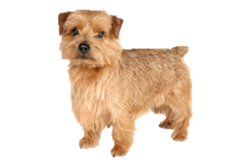
Norfolk Terrier

Cousin to the Norwich


The Norfolk Terrier is a breed of dog that originated in England. It can be distinguished from its close relative, the Norwich by its drop (or folded) ears.


Appearance

Norfolk Terriers are one of the smallest terriers, standing at only ten inches and weigh between 10-12 pounds. They are sturdy dogs with small drop ears and in countries where it is still allowed their tails are traditionally docked to half length. They have a wiry coat that ranges from one and a half to two inches in long. Coat colors include red, tan, black and tan, wheaten or grizzle. They may or may not have dark points and white some have white markings, although they are not desirable in most kennel club standards.

History

The history of the Norfolk Terrier follows that of its cousin, the Norwich Terrier. Considered the same breed until 1964 in the United Kingdom and 1979 in the United States, they remain largely the same in appearance aside from their ears. More history on this breed can be found on our Norwich page.

Temperament

Norwich Terriers are courageous and hardy despite their size. They are a lovable and intelligent breed, fairly easy to train and yet still have independence. Due to their high prey drive they do not do well with non-canine pets, particularly rodents, but they get along well with children. This breed makes a good watchdog and does not bark incessantly.

Health and Care

Generally a healthy breed, the life expectancy of a Norwich Terrier is between 12-15 years. They are prone to genetic eye diseases, luxating patellas, and hip dysplasia.

Norwich Terriers can adapt to apartment life, provided they receive regular exercise. Dogs that are not stimulated can become bored and destructive. Because they were bred for work they enjoy having a job to do and excel in Earthdog, Agility, and Flyball competitions.

This breed sheds little, and their coat is easy to care for, although a quick daily brushing is ideal to remove dead hairs and prevent matting. Regular stripping of the coat is also needed, at minimum twice yearly in the spring and fall.