
Maltese
Bichon Maltais, Maltese Spaniel, Maltese Terrier
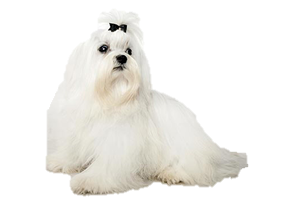
Like the other small, toy breeds, the Maltese has always led the simple life as a companion. In earlier centuries it was also used as a bed warmer by royalty and the upper class. Although only solid white Maltese are bred today coats with markings and even parti-colored were once popular.
The Maltese is one of several breeds included in the bichon family of dogs, the others being the Bichon Frisé, Bolognese, Coton de Tuléar, Havanese, Löwchen, and Russian Tsvetnaya Bolonka.
The Maltese is one of several breeds included in the bichon family of dogs, the others being the Bichon Frisé, Bolognese, Coton de Tuléar, Havanese, Löwchen, and Russian Tsvetnaya Bolonka.
Maltese Standards
- 8-10"
- 4-6 lbs
- small, bichon breed
- ears are drop and heavily feathered
- tail is long, carried over back, plumed
- single coat is long, flat, and silky
- white
History of the Maltese
The Maltese is believed to be one of the oldest breeds of dogs alive today, with ancient texts and archaeological evidence placing dogs of this type in existence as far back as 500 BC. It is commonly accepted as part of the bichon family of dogs, and likely the ancestor to the other breeds in this grouping. (Some give the extinct Bichon Tenerife this title, but the Maltese has been known to exist far before the Tenerife.) Before we explore the origins of the Maltese it is important to note that all of the European bichon-type dogs were likely interbred with each other multiple times throughout history. Unlike other breeds, such as the Basenji, which were isolated with little outside influence, these dogs would have been heavily interbred with each other as they were all small, white dogs, not known as breeds in the sense we view them today.
While the true ancestry of the Maltese is unknown, there are three common theories:
- The Maltese descends from Oriental breeds such as the Tibetan Terrier and Pekingese. Trade between the Mediterranean region and China was not yet established when the Maltese first appears, so this seems implausible. But Oriental dogs could have been used in later development.
- The Maltese is the result of spaniel and water-type dogs such as the Barbet and Poodle. This is unlikely as the breed predates both early spaniels and the Barbet, which is older than the Poodle. However, Toy and Miniature Poodles may have been used in the development of the other bichon breeds.
- The Maltese was bred from a pre-historic spitz from Switzerland which was bred down in size and the coat lengthened and flattened.
It is entirely possible that all or none of these theories played a part in the Maltese development, or perhaps they were selectively bred from dogs already present in the region. However they came to be the Maltese became refined the Mediterranean and was a favorite of both the ancient Greeks and Romans. Along with the tiny Italian Greyhound, the 'Melitae' or 'Melitaie' were the most popular dogs with the wealthy women throughout the Roman Empire. The Romans (likely aided by the Phoenicians) spread these little dogs across Europe, including into the lands of what is now France, Italy, and Spain, where it would remain popular throughout the centuries.
As it spread other breeds developed from the bloodline. In Italy the Maltese gave rise to the Bolognese and in France and Belgium the Bichon Frisé. On separate islands the Bichon Tenerife and Coton de Tuléar would also descend from this stock, and much later the Havanese in Cuba. A legend even persists that several shipwrecked Maltese off Scotland was used to create the Skye Terrier.
Related Breeds: