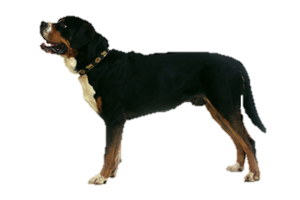
Greater Swiss Mountain Dog

Grosser Schweizer Sennenhund

The Greater Swiss Mountain Dog is a herding breed that originated in Switzerland. They are one of the four Sennenhunds, or Swiss Mountain Dogs, the other three being the Berner, Appenzeller, and Entelbucher. All four of these breeds share the same coat colors, although they very in size. The Greater Swiss Mountain Dog is the largest and oldest of the Sennenhunds.


Appearance

A large breed of the Molosser type, the Greater Swiss Mountain Dog stands between 23-29 inches and weighs in at 130-135 pounds. They have a short double coat that is tricolor, black with rust and white. There should be rust markings over each eye, on the cheeks, legs, and either side of the chest. The white should be on the muzzle, feet, tip of the tail, chest, muzzle, and a blaze on the forehead.

History

It is believed that the Greater Swiss Mountain Dog is descended from large Molossers brought to Switerland either by the Romans or Phoenician traders. The word Senn is the term for Alpine herdsmen, so a Sennenhund is a “dog of the Senn”. They were general farm dogs, used for herding, as livestock guardians, and for pulling carts; giving them the nickname of “the poor man’s horse”. By the end of the 19th century the largest of the four Sennenhunds had almost become extinct, the need for their services slowly being replaced by machines. In 1908 the 25th anniversary of the Swiss Kennel Club was held at Langenthal. A pair of short-haired Bernese Mountain Dogs was shown, and one of the judges, a Swiss breed advocate named Albert Heim, recognized them as the vanishing larger type. It had been assumed that they had already died out, but at Heim’s urging other dogs were located and slowly the bloodline was recovered. The Greater Swiss Mountain Dog was recognized as its own breed by the Swiss Kennel Club two short years later in 1910.

Temperament

Greater Swiss Mountain Dogs are loyal and eager to please. They get along well with children and bond well with their family. Most get along well with other dogs and non-canine pets if properly socialized at a young age. A natural watchdog, the Greater Swiss can be suspicious of strangers.

Health and Care

The lifespan of a Greater Swiss Mountain Dog is generally 10-11 years. Some known genetic disorders are hip dysplasia and epilepsy. This breed is also prone to bloat, so care should be given when feeding.

The Greater Swiss Mountain Dog is not suited for apartment life, they should have at least a small yard. As with all breeds, they need a daily walk.

The coat of a Greater Swiss Mountain Dog is fairly easy to keep in top condition, it just requires regular brushing. They are average shedders.